Our Lecturers
Our own professionally qualified tutors are suitably trained in their respective subjects committed to provide any support required to any student, whatever the student’s knowledge and background. Lecturers have past experience in tuition at various other higher education institutions and therefore can adapt to accommodate our students needs.
Entry Requirements
RDC Training Centre aims to provide accessible and inclusive training while ensuring that all learners are able to successfully follow the course and achieve the intended learning outcomes. In line with this approach, applicants are expected to meet a number of basic entry requirements applicable to all accredited courses offered by the institution.
Applicants must be at least sixteen (16) years of age at the time of course commencement. Participants are also expected to possess a basic level of language comprehension in Maltese, English, or Italian. This is necessary to ensure that learners can follow verbal explanations, understand course materials, instructions, and complete assessments effectively. Training sessions and assessments may be delivered in Maltese, English, or Italian, depending on the needs of the participants.
RDC Training Centre recognises that a significant proportion of its learners come from practical and vocational backgrounds, and may have varying levels of literacy. For this reason, the institution adopts a student-centred and inclusive approach to teaching and assessment. Training is supported through the use of simplified language, visual aids, demonstrations, and practical examples. Assessment methods are designed to be accessible and fair, and may include multiple-choice questions and practical evaluations, ensuring that learners are able to demonstrate their competence without unnecessary barriers.
For courses that include practical components, particularly those related to construction, lifting operations, or emergency response, participants are expected to be physically capable of safely engaging in such activities. Any specific requirements related to individual courses will be communicated in advance.

Award in Food Handling – MQF level 2
Scope
Successful candidates receive a Food Handlers Category B certification, valid for five years. This will be issued by the Food Safety Commission on successful completion of the Food Handler’s Course.
This course is designed for people engaged in the preparation and handling of food (e.g. Fresh Cream, Custard, Meat, Poultry, Sausages, Eggs, Rice, Fish, Cheese, Milk, Shellfish.). Our aim is to give an in-depth knowledge of the food hygiene principles end share good work practices with the food handler.
Topics covered:
- The importance of hygiene in the food industry.
- Pathogenic organisms – the potential to cause illness.
- High and low risk foods.
- Causes of food poisonings and how to avoid them.
- Personal health & hygiene: importance; the need to report illness.
- Cross contamination: its causes and prevention.
- Food storage: protection; temperature control; rotation.
- ‘Foreign bodies’ in food: types and prevention.
- Cleaning & disinfection: materials used, methods, storage of detergents.
- Waste disposal: storage and hygienic disposal.
- Pests control: importance of control.
- Legal requirements as per local legislation.
- Any particular topic related to the delegates’ job.
- Instruction on control and monitoring of critical points related to the delegates’ job.
- Information on Animal By- Products
- Allergens
Guided learning hours: - 18 hrs
Total qualification time: - 25 hrs
ECTS Credit Value: - 1 ECTS
delivery method: - Training is delivered through a combination of:
- classroom-based instruction,
- practical demonstrations,
- tutor-led discussions,
- scenario-based learning,
- audiovisual presentations,
- guided practical exercises,
- and workplace-related examples.
Learning outcomes
Upon successful completion of this course, learners will be able to:
- understand the importance of food safety and hygiene within the food handling industry;
- identify common food hazards, including biological, chemical, physical, and allergen-related hazards;
- explain the causes and prevention of food contamination and food poisoning;
- apply good personal hygiene practices when handling food;
- demonstrate correct cleaning and sanitisation procedures for food preparation areas and equipment;
- identify safe food storage procedures, including temperature control requirements for hot and cold food;
- recognise the importance of preventing cross-contamination during food preparation and handling;
- understand the legal responsibilities of food handlers and employers under Maltese food safety legislation;
- follow safe procedures for receiving, storing, preparing, cooking, serving, and transporting food;
- recognise the importance of pest control and waste management in maintaining food safety standards;
- demonstrate awareness of allergen management and the risks associated with food allergies;
- apply safe workplace practices to maintain a hygienic food handling environment.
Assessment method: Multiple choice and practical’s
Date of next intake: – Contact us by phone 27893265 or via email info.rdcmalta@gmail.com
Mode of attendance: In Class or on line
Grading system: - RDC Training Centre applies a fair, transparent, and consistent assessment system designed to evaluate whether learners have achieved the intended learning outcomes of the course.
Candidates will be assessed on all the above-listed components. Candidates will be assessed on Knowledge and understanding orally during an interview and or in writing through a multiple-choice test paper. In order to pass the assessment, candidates need to prove their competencies in all enlisted criteria above.
Assessment methods may include:
- multiple-choice assessments,
- practical demonstrations,
- oral questioning,
- observation of practical competence,
- classroom participation,
- and other methods appropriate to the nature of the programme.
To successfully complete the course and obtain certification, learners must achieve a minimum pass mark of 70%.
Reassessment opportunities may be provided in accordance with institutional procedures.
Language: - Maltese, English, or Italian
*Accreditation is a form of certification in which the MFHEA will verify that an academic or vocational programme meets minimum academic and vocational standards. Accreditation ensures that the qualification a student works so hard to obtain meets quality standards, and that it will be recognized as such by other educational institutions and employers. The decisive stage of accreditation is the mapping of the programme to the Malta Qualifications Framework (MQF) and the European Qualifications Framework (EQF) - further information on the MFHEA and the MQF/EQF may be obtained from www.mfhea.mt

Award in Limestone & Hollow Concrete Block Laying – MQF level 3
In order to obtain the skill card issued by BICC, along with this course one could also do one of our Heath and Safety courses (MQF level 3)
Eligibility
Candidates who are interested in acquiring the Award in Limestone & Hollow Concrete Block Laying. Basic knowledge in construction industry is required.
Course Contents
This includes course materials and expert tutoring to give learners in-depth training in the following:
- Health and safety during work practices
- Identification of construction systems, equipment and components
- Reading of drawings and calculations
- Laying of limestone and hollow concrete blocks
Guided learning hours: - 45 hrs
Total qualification time: - 75 hrs
ECTS Credit Value: - 4 ECTS
delivery method: - Training is delivered through a combination of:
- classroom-based instruction,
- practical demonstrations,
- tutor-led discussions,
- scenario-based learning,
- audiovisual presentations,
- guided practical exercises,
- and workplace-related examples.
Learning outcomes
Upon successful completion of this course, learners will be able to:
- identify the different types of limestone and hollow concrete blocks commonly used in construction works;
- understand the basic principles of masonry and block laying within the construction industry;
- recognise workplace health and safety requirements related to block laying activities and construction sites;
- identify the correct tools, equipment, and materials used for limestone and hollow concrete block laying;
- prepare mortar mixes using appropriate materials and methods;
- demonstrate correct manual handling techniques for construction materials and equipment;
- interpret basic construction drawings, measurements, and layout markings relevant to masonry works;
- apply correct techniques for laying limestone blocks and hollow concrete blocks safely and accurately;
- maintain correct alignment, levels, bonding patterns, and joint spacing during block laying operations;
- identify common defects and errors in masonry work and apply corrective measures where necessary;
- demonstrate safe working practices when using hand tools, power tools, and construction equipment;
- maintain a clean, organised, and safe working environment during construction activities;
- recognise the importance of teamwork, communication, and professional conduct within construction site operations;
- apply practical masonry skills in accordance with industry standards and site requirements.
Assessment method: Multiple choice and practical’s
Date of next intake: – Contact us by phone 27893265 or via email info.rdcmalta@gmail.com
Mode of attendance: In Class or on line
Grading system: - RDC Training Centre applies a fair, transparent, and consistent assessment system designed to evaluate whether learners have achieved the intended learning outcomes of the course.
Assessment methods may include:
- multiple-choice assessments,
- practical demonstrations,
- oral questioning,
- observation of practical competence,
- classroom participation,
- and other methods appropriate to the nature of the programme.
To successfully complete the course and obtain certification, learners must achieve a minimum pass mark of 70%.
Reassessment opportunities may be provided in accordance with institutional procedures.
Candidates will be assessed on all the above-listed components. Candidates will be assessed on Knowledge and understanding orally during an interview and or in writing through a multiple-choice test paper. In order to pass the assessment, candidates need to prove their competencies in all enlisted criteria above.
Language: - Maltese, English, or Italian
*Accreditation is a form of certification in which the MFHEA will verify that an academic or vocational programme meets minimum academic and vocational standards. Accreditation ensures that the qualification a student works so hard to obtain meets quality standards, and that it will be recognized as such by other educational institutions and employers. The decisive stage of accreditation is the mapping of the programme to the Malta Qualifications Framework (MQF) and the European Qualifications Framework (EQF) - further information on the MFHEA and the MQF/EQF may be obtained from www.mfhea.mt

Builders licence - Certificate of attendance
This course also includes the following certification ‘Award in Limestone & Hollow Concrete Block Laying’ and ’ Award in Health & Safety at the workplace.
Eligibility
Candidates who are interested in acquiring the Builders license, as issued by Building and Construction Authority in Malta. Knowledge and experience in the construction industry required.
Course Contents
This includes course materials and expert tutoring to give learners in-depth training in the following:
- Health and safety during work practices
- Walls and Alterations
- Scales, Plans & Calculations
- Geometry
- Arches
- Foundations
- Laws and Regulations
- Concrete
Assessment
Candidates will be given synoptic scenarios on all the above-listed components. Practical sessions will be given in class. Candidates will have enough practice in class, both in theory and drawings in actual size, and therefore will be able to take the exam @ BCA.

Award in Health and Safety at the Workplace. – MQF level 2
In order to obtain the skill card issued by BICC, along with this course one could also do one of our other courses MQF Level 2 or higher.
Scope
This health and safety training introduction course gives the basic yet essential knowledge to help them stay safe and look after others in the workplace. Good health and safety awareness not only helps to keep employees safe, but it also minimises the risk of injuries which can keep them out of work for weeks or months. Even the basics of health and safety contain some invaluable procedures, which can help prevent many of the most common workplace accidents from occurring. Our health & safety training introductory course will give learners knowledge of the latest health & safety procedures to cover a wide range of scenarios including accident procedures, manual handling, fire regulations, equipment use and meeting local regulations.
Course Contents
This includes course materials and expert tutoring to give learners in-depth training in the following:
- Legislation and regulations
- Health & Safety in the workplace
- Welfare of employees
- Accident procedures
- Manual handling procedures
- Manual handling regulations
- Safe systems of work
- Work equipment
- Recognise a small fire
- Fire Extinguisher / Blanket
- Take Care of an Injured Person / First aid provisions
- The Role of a Fire Warden
Guided learning hours: - 18 hrs
Total qualification time: - 25 hrs
ECTS Credit Value: - 1 ECTS
delivery method: - Training is delivered through a combination of:
- classroom-based instruction,
- practical demonstrations,
- tutor-led discussions,
- scenario-based learning,
- audiovisual presentations,
- guided practical exercises,
- and workplace-related examples.
Learning outcomes
Upon successful completion of this course, learners will be able to:
- understand the importance of occupational health and safety within the workplace environment;
- identify common workplace hazards, including physical, chemical, biological, ergonomic, and psychosocial hazards;
- recognise the legal responsibilities of employers and employees under occupational health and safety legislation;
- identify unsafe acts and unsafe conditions that may lead to accidents or injuries at work;
- apply basic risk assessment principles to identify hazards and implement suitable control measures;
- recognise the importance of safe working procedures and compliance with workplace safety rules;
- demonstrate awareness of emergency procedures, including fire safety, evacuation procedures, and accident reporting;
- identify the correct use and importance of personal protective equipment (PPE);
- understand the importance of maintaining good housekeeping practices to prevent workplace accidents;
- recognise common manual handling risks and apply safe lifting and handling techniques;
- understand the importance of reporting hazards, near misses, incidents, and unsafe situations;
- demonstrate awareness of employee wellbeing and the importance of maintaining a safe and healthy working environment;
- contribute towards creating a positive health and safety culture within the workplace;
- apply basic occupational health and safety principles in practical workplace situations.
Assessment method: Multiple choice and practical’s
Date of next intake: – Contact us by phone 27893265 or via email info.rdcmalta@gmail.com
Mode of attendance: In Class or on line
Grading system: - RDC Training Centre applies a fair, transparent, and consistent assessment system designed to evaluate whether learners have achieved the intended learning outcomes of the course.
Assessment methods may include:
- multiple-choice assessments,
- practical demonstrations,
- oral questioning,
- observation of practical competence,
- classroom participation,
- and other methods appropriate to the nature of the programme.
To successfully complete the course and obtain certification, learners must achieve a minimum pass mark of 70%.
Reassessment opportunities may be provided in accordance with institutional procedures.
Candidates will be assessed on all the above-listed components. Candidates will be assessed on Knowledge and understanding orally during an interview and or in writing through a multiple-choice test paper. In order to pass the assessment, candidates need to prove their competencies in all enlisted criteria above.
Language: - Maltese, English, or Italian

Award in Health & Safety for Managers – MQF Level 4
In order to obtain the skill card issued by BICC, along with this course one could also do one of our other courses MQF Level 2 or higher (except from the ‘Award in Health & Safety at the workplace’).
Scope
This course aims to inspire senior management and provide them with an understanding of their responsibility for the health, safety, environment, and wellbeing of people in their organisation. This level 4 course is an interactive course that provides practical advice on effective leadership in health, safety, environment, and wellbeing. The course is particularly important for any client’s organisation because the Occupational Health and Safety Authority has tightened regulation and is imposing fines on businesses that are not complying with the regulations and guidelines.
Course Contents
This includes course materials and expert tutoring to give learners in-depth training in the following:
- OHSA and its subsidiary legislation
- Health and Safety Policy - LEGAL ASPECT
- Process safety analysis
- Emergency & evacuation
- Workstation Safety – Accidents
- Reactive monitoring
- Hazards and identification techniques
- Hierarchy of controls
- Upgrading, Maintenance & cleaning Works
- Safe system of work
- Health and Safety audit and Report writing
- Organising and planning
Guided learning hours: - 42 hrs
Total qualification time: - 75 hrs
ECTS Credit Value: - 2 ECTS
Delivery method: - Training is delivered through a combination of:
- classroom-based instruction,
- practical demonstrations,
- tutor-led discussions,
- scenario-based learning,
- audiovisual presentations,
- guided practical exercises,
- and workplace-related examples.
Learning outcomes
Upon successful completion of this course, learners will be able to:
- understand the roles and responsibilities of managers in promoting occupational health and safety within the workplace;
- interpret the main principles of occupational health and safety legislation and employer obligations;
- identify workplace hazards and evaluate risks associated with different work activities and environments;
- apply risk assessment principles and implement appropriate control measures to reduce workplace risks;
- develop and promote a positive health and safety culture within the organisation;
- understand the importance of effective communication and consultation on health and safety matters with employees and other stakeholders;
- recognise the importance of safe systems of work, workplace procedures, and compliance monitoring;
- identify appropriate measures for accident prevention and incident reduction within the workplace;
- understand the procedures for reporting, recording, and investigating workplace accidents, incidents, and near misses;
- recognise the importance of employee wellbeing, mental health, and occupational welfare within the workplace;
- identify suitable emergency preparedness and response procedures, including fire safety and evacuation planning;
- understand the importance of training, supervision, and competence in maintaining workplace safety standards;
- demonstrate awareness of the importance of continuous monitoring and review of workplace health and safety performance;
Assessment method: Test paper and presentation
Date of next intake: – Contact us by phone 27893265 or via email info.rdcmalta@gmail.com
Mode of attendance: In Class or on line
Grading system: - RDC Training Centre applies a fair, transparent, and consistent assessment system designed to evaluate whether learners have achieved the intended learning outcomes of the course.
Assessment methods may include:
- multiple-choice assessments,
- practical demonstrations,
- oral questioning,
- observation of practical competence,
- classroom participation,
- and other methods appropriate to the nature of the programme.
To successfully complete the course and obtain certification, learners must achieve a minimum pass mark of 70%.
Reassessment opportunities may be provided in accordance with institutional procedures.
Candidates will be assessed on all the above-listed components. Candidates will be assessed on Knowledge and understanding orally during an interview and or in writing through a multiple-choice test paper. In order to pass the assessment, candidates need to prove their competencies in all enlisted criteria above.
Language: - Maltese, English, or Italian

Construction project Management
In order to obtain the skill card issued by BICC, along with this course one could also do one of our Heath and Safety courses.
Scope
The main aspects of a good project manager are technical skills, modern vision and proactive leadership. A project lifecycle can vary from one project to another so the project manager needs to be prepared for the unexpected. The project manager needs to look at the engineering project as a cohesive process, examining projects from initiation through to completion. By the end of this course, the student will have gained practical experience with project management, allowing him /her to excel within the current role or land the next job up.
Course Contents
This includes course materials and expert tutoring to give learners in-depth training in the following:
- Maltese guidelines and legislation surrounding construction
- Understanding of the social, economic, and environmental issues commonly affecting construction problems
- Design principles and applications
- Science and materials for construction projects
- Project management processes and strategies
- Sustainability in the Construction Industry
- Roles and responsibilities of a Construction Manager
- Project management tools, techniques, and software
Assessment
Candidates will be assessed on all the above-listed components. Each module is assessed through mini assignments, which will carry out 30 % of the final mark. Upon completion of the course, a final assignment will cover the remaining 70% of the mark. In order to pass the assessment, candidates need to prove their competencies in all enlisted criteria above.
NOTE. Kindly be informed that this programme is not accredited. Upon successful completion, participants will be awarded a Certificate of Attendance.
Should you wish to express your interest in registering for this educational programme, you are kindly requested to contact us.

Award in lifting Methods and equipment at the work place – MQF Level 2
Forklift, Mobile / Tower Crane, Excavator etc.
In order to obtain the skill card issued by BICC, along with this course one could also do one of our Heath and Safety courses (MQF level 2 or 4)
Scope
The aim of the Course is to enable the correction of any know issues and enhance the knowledge of operators. The Course can be customised to fit the applicant’s requests, therefore eliminate topics that are not applicable. Our instructor will conduct a live working environment ‘walk through’ prior to on-site classes. The aim is to understand better a client’s applications and policies to ensure the best training outcome. Our experienced instructor will make suggestions for safety improvement and national law compliance. We can conduct on site visits for a hands-on evaluation of a client’s requirement. In case a client doesn’t have training equipment, RDConsultants can offer an alternative.
Course Contents
This includes course materials and expert tutoring to give learners in-depth training in the following:
- Definitions
- Lifting Equipment Safety & setup
- Duties and Responsibilities
- Introduction and Explanation of Capacities & Load Charts
- Safe Loading
- Lifting Plan- Things to Check
- Wind Forces and Turning Gear
- Signalling/Slinging
- Lifting Gear Chains/ Wire Rope Slings
- Basic Inspection of Lifting equipment
- General Information about Densities of Material being lifted
- Risk Assessment
- Schedule of Common Lifts
- On-site Basic Test
Guided learning hours: - 18 hrs
Total qualification time: - 25 hrs
ECTS Credit Value: - 1 ECTS
Delivery method: - Training is delivered through a combination of:
- classroom-based instruction,
- practical demonstrations,
- tutor-led discussions,
- scenario-based learning,
- audiovisual presentations,
- guided practical exercises,
- and workplace-related examples.
Learning outcomes
Upon successful completion of this course, learners will be able to:
- understand the basic principles of safe lifting operations within the workplace;
- identify different types of lifting equipment and lifting accessories commonly used in workplace operations;
- recognise workplace hazards and risks associated with lifting activities and lifting equipment;
- understand the legal responsibilities related to lifting operations and workplace safety;
- identify the correct selection and safe use of lifting equipment appropriate to specific lifting tasks;
- demonstrate awareness of safe lifting methods and proper lifting techniques;
- recognise the importance of pre-use inspections and routine checks on lifting equipment and accessories;
- identify defective or unsafe lifting equipment and understand the importance of reporting faults and unsafe conditions;
- understand safe load handling principles, including load stability, load limits, and weight distribution;
- recognise the importance of communication and signalling during lifting operations;
- demonstrate awareness of safe working practices when working near suspended loads and lifting machinery;
- understand the importance of personal protective equipment (PPE) during lifting activities;
- maintain safe housekeeping and organisational practices within lifting operation areas;
- apply safe lifting procedures and workplace safety principles during practical lifting activities.
Assessment method: Multiple choice and practical’s
Date of next intake: – Contact us by phone 27893265 or via email info.rdcmalta@gmail.com
Mode of attendance: In Class or on line
Grading system: - RDC Training Centre applies a fair, transparent, and consistent assessment system designed to evaluate whether learners have achieved the intended learning outcomes of the course.
Assessment methods may include:
- multiple-choice assessments,
- practical demonstrations,
- oral questioning,
- observation of practical competence,
- classroom participation,
- and other methods appropriate to the nature of the programme.
To successfully complete the course and obtain certification, learners must achieve a minimum pass mark of 70%.
Reassessment opportunities may be provided in accordance with institutional procedures.
Candidates will be assessed on all the above-listed components. Candidates will be assessed on Knowledge and understanding orally during an interview and or in writing through a multiple-choice test paper. In order to pass the assessment, candidates need to prove their competencies in all enlisted criteria above.
Language: - Maltese, English, or Italian

Scaffolding erection, dismantling & Inspection. - Certificate of attendance
In order to obtain the skill card issued by BICC, along with this course one could also do one of our Heath and Safety courses.
Scope
RDC Training centre offers a selection of scaffold erection, dismantling & Inspection courses, we can adapt the course according to our audience skills and also instructing on particular scaffold models.
Our Scaffold training courses equips attendees with the knowledge to enable them to understand how to build & inspect basic scaffolding structures, in accordance with the OHSA Regulations.
For more experienced skilled workers, and managerial level, we offer the Advanced Scaffold Inspection course, which teaches the skills necessary for those who are responsible for large and complex scaffolds.
If you would like to find out more about our scaffolding courses, please contact us in order to design the best scaffold course as required by your team.
Course Contents
This includes course materials and expert tutoring to give learners in-depth training in the following:
- Introduction to scaffolding terminology
- Working at heights and OHSA Regulations
- Industrial standards
- Various types of scaffolds
- Safe access and egress
- Working methods and training
- Bracing and tying scaffolds
- Loading a scaffold
- Basic scaffold inspections
Assessment
Candidates will be assessed on all the above-listed components. Candidates will be assessed on Knowledge and understanding orally during an interview and/or in writing through a multiple-choice test paper. Candidates will also be tested on specific equipment in real-life scenarios. In order to pass the assessment, candidates need to prove their competencies in all enlisted criteria above.
NOTE. Kindly be informed that this programme is not accredited. Upon successful completion, participants will be awarded a Certificate of Attendance.
Should you wish to express your interest in registering for this educational programme, you are kindly requested to contact us.

Emergency & Evacuation Training / Fire Warden - Certificate of attendance
Scope
Lives can be saved and damage to property can be minimalised when people are prepared and have the necessary skills gained from emergency response training.
There are many instances when emergency medical services, and in worst case scenarios, emergency services will not always be on time to respond. Therefore it pays off to have people trained in emergency response who can assess any emergency situation and provide the correct help when necessary. Fires, explosions, chemical releases, violence or biological releases all pose a threat to everyone. One way to ensure the safety of all affected populations, and reduce the risk to your organisation, is to have an evacuation plan.
One of the most devastating losses to an organisation is the loss of human life. Apart from the emotional cost, it will inevitably lead to adverse publicity, significant costs in repairing and recovery of operations, large financial settlements, loss of organisational talent and leadership, impaired trading and severe its ability to deliver its product and quality of service. An emergency evacuation plan can make life-or death differences for your staff, volunteers, visitors, vendors and programme participants. It could also mean life or death for your mission.
Course Contents
This includes course materials and expert tutoring to give learners in-depth training in the following:
- Purpose of an emergency action plan
- Fire Safety – Housekeeping
- Evacuation procedures – the Need to Know
- Preplanning - Protecting your co-workers’ clients and your business
- Types of emergencies & the emergency scene
- Evacuations routes, exits and signs
- General evacuation and duties
- Evacuation Plan, & TrainingGuided learning hours: - 18 hrs
Total qualification time: - 25 hrs
ECTS Credit Value: - 1 ECTS
delivery method: - Training is delivered through a combination of:
- classroom-based instruction,
- practical demonstrations,
- tutor-led discussions,
- scenario-based learning,
- audiovisual presentations,
- guided practical exercises,
- and workplace-related examples.
Assessment method: Multiple choice and practical’s
Date of next intake: – Contact us by phone 27893265 or via email info.rdcmalta@gmail.com
Mode of attendance: In Class or on line
Grading system: - RDC Training Centre applies a fair, transparent, and consistent assessment system designed to evaluate whether learners have achieved the intended learning outcomes of the course.
Assessment methods may include:
- multiple-choice assessments,
- practical demonstrations,
- oral questioning,
- observation of practical competence,
- classroom participation,
- and other methods appropriate to the nature of the programme.
To successfully complete the course and obtain certification, learners must achieve a minimum pass mark of 70%.
Reassessment opportunities may be provided in accordance with institutional procedures.
Candidates will be assessed on all the above-listed components. Candidates will be assessed on Knowledge and understanding orally during an interview and or in writing through a multiple-choice test paper. In order to pass the assessment, candidates need to prove their competencies in all enlisted criteria above.
Language: - Maltese, English, or Italian

Award in Basic Fire Awareness - MQF Level 2
Scope
The BFA training provides participants with greater awareness and understanding of the dangers of fire and helps them to identify and reduce the risk that fire presents in the workplace. Participants will understand the actions to take in the event of discovering a fire or hearing the fire alarm sound in the workplace.
Course Contents
This includes course materials and expert tutoring to give learners in-depth training in the following:
- A greater awareness of the dangers of fire and smoke
- Awareness of all fire safety measures in the workplace
- An understanding of their actions in the event of fire
- Confidence in identifying and operating firefighting equipment
- Awareness of potential fire hazards in the workplace
Guided learning hours: - 18 hrs
Total qualification time: - 25 hrs
ECTS Credit Value: - 1 ECTS
delivery method: - Training is delivered through a combination of:
- classroom-based instruction,
- practical demonstrations,
- tutor-led discussions,
- scenario-based learning,
- audiovisual presentations,
- guided practical exercises,
- and workplace-related examples.
Learning outcomes
Upon successful completion of this course, learners will be able to:
1. understand the basic principles of fire safety and fire prevention within the workplace;
2. identify the common causes of fire and recognise potential fire hazards in different work environments;
3. explain the fire triangle and the conditions required for fire to occur and spread;
4. recognise the different classes of fire and the appropriate methods for dealing with each type;
5. identify the different types of fire extinguishers and their correct use;
6. demonstrate awareness of basic fire-fighting procedures and personal safety precautions during fire emergencies;
7. understand the importance of emergency procedures, fire alarms, and evacuation processes;
8. recognise the roles and responsibilities of employees during a fire emergency;
9. identify safe evacuation routes, assembly points, and emergency exit procedures;
10. understand the importance of maintaining clear access to fire safety equipment and escape routes;
11. recognise the importance of workplace housekeeping in reducing fire risks;
12. identify the importance of regular fire safety checks, inspections, and maintenance of fire safety equipment;
13. demonstrate awareness of the importance of communication and reporting during fire-related emergencies;
14. apply basic fire awareness and fire prevention principles within workplace environments. Assessment method: Multiple choice and practical’s
Date of next intake: – Contact us by phone 27893265 or via email info.rdcmalta@gmail.com
Mode of attendance: In Class or on line
Grading system: - RDC Training Centre applies a fair, transparent, and consistent assessment system designed to evaluate whether learners have achieved the intended learning outcomes of the course.
Assessment methods may include:
- multiple-choice assessments,
- practical demonstrations,
- oral questioning,
- observation of practical competence,
- classroom participation,
- and other methods appropriate to the nature of the programme.
To successfully complete the course and obtain certification, learners must achieve a minimum pass mark of 70%.
Reassessment opportunities may be provided in accordance with institutional procedures.
Candidates will be assessed on all the above-listed components. Candidates will be assessed on Knowledge and understanding orally during an interview and or in writing through a multiple-choice test paper. In order to pass the assessment, candidates need to prove their competencies in all enlisted criteria above.
Language: - Maltese, English, or Italian

Award in Basic First Aid - MQF Level 3
incl. Paediatric and / or AED (Automated External Defibrillator)
Scope
The First Aid course is the standard training recommended for workplace first aid providers. It is also applicable to anyone who would like to be able to help during a medical emergency. This course covers a broad range of topics to enable participants to confidently manage emergency situations and provide a first aid response to a casualty. The course includes paediatric (children & babies) First Aid.
Course Contents
This includes course materials and expert tutoring to give learners in-depth training in the following:
By the end of this training the participants will be:
- able to recognise life-threatening situations
- able to offer vital assistance before more experienced help arrives
- able to provide single-person CPR on an adult, child and baby
- qualified as a workplace first aid person
Guided learning hours: - 18 hrs
Total qualification time: - 25 hrs
ECTS Credit Value: - 1 ECTS
delivery method: - Training is delivered through a combination of:
- classroom-based instruction,
- practical demonstrations,
- tutor-led discussions,
- scenario-based learning,
- audiovisual presentations,
- guided practical exercises,
- and workplace-related examples.
Learning outcomes
Upon successful completion of this course, learners will be able to:
1. understand the role and responsibilities of a basic first aider within the workplace and everyday situations;
2. identify common emergencies requiring first aid assistance and respond appropriately while ensuring personal safety;
3. assess an emergency situation and apply basic first aid principles in a calm and effective manner;
4. demonstrate awareness of the importance of contacting emergency services and providing accurate information during emergencies;
5. recognise the signs and symptoms of an unconscious casualty and apply appropriate first aid procedures;
6. demonstrate basic cardiopulmonary resuscitation (CPR) techniques in accordance with current guidelines;
7. identify and respond appropriately to choking incidents in adults;
8. recognise and provide basic first aid treatment for bleeding, cuts, burns, fractures, sprains, and minor injuries;
9. understand the importance of infection prevention and hygiene during first aid interventions;
10. demonstrate awareness of safe casualty handling and recovery position procedures;
11. identify common medical emergencies such as shock, seizures, heart attack, stroke, and allergic reactions;
12. recognise the importance of maintaining a stocked and accessible first aid kit within the workplace;
13. demonstrate effective communication and reassurance techniques when assisting injured or ill persons;
14. apply basic first aid knowledge and practical skills safely and responsibly within workplace and everyday environments.
Assessment method: Multiple choice and practical’s
Date of next intake: – Contact us by phone 27893265 or via email info.rdcmalta@gmail.com
Mode of attendance: In Class or on line
Grading system: - RDC Training Centre applies a fair, transparent, and consistent assessment system designed to evaluate whether learners have achieved the intended learning outcomes of the course.
Assessment methods may include:
- multiple-choice assessments,
- practical demonstrations,
- oral questioning,
- observation of practical competence,
- classroom participation,
- and other methods appropriate to the nature of the programme.
To successfully complete the course and obtain certification, learners must achieve a minimum pass mark of 70%.
Reassessment opportunities may be provided in accordance with institutional procedures.
Candidates will be assessed on all the above-listed components. Candidates will be assessed on Knowledge and understanding orally during an interview and or in writing through a multiple-choice test paper. In order to pass the assessment, candidates need to prove their competencies in all enlisted criteria above.
Language: - Maltese, English, or Italian

Chemical Safety - Certificate of attendance
Scope
The Award in Chemical Safety is designed to give an overview of the chemicals used at the workplace and provide an evaluation work processes that can release a variety of harmful substances that are hazardous to the health and environment. Chemicals may also be associated with fire and explosion hazards.
Our training is suitable for people who want to improve occupational health and safety at their workplace. The Course is intended for shop floor employees, occupational health care specialists, and other managerial posts.
Course Contents
This includes course materials and expert tutoring to give learners in-depth training in the following:
- All material safety data sheet
- Assessment of health risks of chemicals in specific occupations
- Chemical safety at the workplace
- Occupational risks management
- Communicate of safety hazards
- Follow basic occupational Health and safety procedures
- Preventive measures and engineering controls
Assessment
Candidates will be assessed on all the above-listed components. Candidates will be assessed on Knowledge and understanding orally during an interview and/or in writing through a multiple-choice test paper. In order to pass the assessment, candidates need to prove their competencies in all enlisted criteria above.
NOTE. Kindly be informed that this programme is not accredited. Upon successful completion, participants will be awarded a Certificate of Attendance.
Should you wish to express your interest in registering for this educational programme, you are kindly requested to contact us.

Process Safety Analysis / Principles of Risk Assessment - Certificate of attendance
Scope
This course is designed for all types of work places, due to the fact that risk assessments are a legal requirement. This course helps you to identify the health and safety issues within your daily job. You will learn how to go through the key steps of a risk assessment, including how to identify risks, manage hazards and determine the likelihood of harm.
Course Contents
This includes course materials and expert tutoring to give learners in-depth training in the following:
- Principles of health and safety
- Inspections
- Task risk assessment
- Organisation of work
- Preparing / abiding by the Safe operation procedures (SOP’s)
Assessment
Candidates will be assessed on all the above-listed components. Candidates will be assessed on Knowledge and understanding orally during an interview and or in writing through a multiple-choice test paper. In order to pass the assessment, candidates need to prove their competencies in all enlisted criteria above.
NOTE. Kindly be informed that this programme is not accredited. Upon successful completion, participants will be awarded a Certificate of Attendance.
Should you wish to express your interest in registering for this educational programme, you are kindly requested to contact us.
Teaching Staff and Tutors
RDC Training Centre is committed to ensuring that all teaching staff possess the necessary academic qualifications, vocational competence, industry experience, and teaching skills required to effectively deliver accredited programmes.
The institution engages tutors who have substantial practical experience within their respective fields, particularly in occupational health and safety, construction safety, emergency response, first aid, and related compliance sectors. Tutors are selected based on their professional competence, communication skills, industry knowledge, and ability to deliver student-centred learning.
RDC recognises the importance of combining academic knowledge with practical industry expertise. For this reason, tutors are expected to maintain active involvement within their professional sectors and remain updated with current legislation, industry standards, and best practices.
All tutors engaged by RDC are required to:
- possess relevant qualifications related to the subject area being delivered;
- demonstrate practical industry experience;
- maintain professional conduct and ethical standards;
- participate in Continuous Professional Development (CPD);
- support students through inclusive and accessible teaching methods.
Mr Roderick Cassar – Head of Institution and Tutor
Mr Roderick Cassar is the founder and Head of Institution of RDC Training Centre and possesses extensive professional experience in occupational health and safety, construction safety, workplace risk management, engineering-related operations, and vocational training.
He has worked for many years within the construction, infrastructure, education, and industrial sectors, undertaking responsibilities related to occupational health and safety inspections, risk assessments, project supervision, training delivery, and compliance monitoring across a wide range of projects and workplaces.
Mr Cassar recently obtained a Bachelor’s Degree with Honours in Engineering, further strengthening his technical and professional expertise within the engineering and occupational health and safety sectors. He also holds qualifications in Occupational Health and Safety, Computer Aided Design, and Engineering-related studies.
Throughout his professional career, Mr Cassar has been actively involved in:
- occupational health and safety consultancy;
- construction and infrastructure projects;
- workplace inspections and audits;
- preparation of risk assessments and method statements;
- health and safety training delivery;
- emergency preparedness and first aid training;
- vocational education and learner support.
His experience includes work carried out in collaboration with major organisations and projects, including the University of Malta, infrastructure and road projects, industrial operations, educational institutions, and large-scale construction developments.
Mr Cassar is a certified trainer in several occupational health and safety subject areas and is a registered Occupational Health and Safety Competent Person. He is also a member of the Malta Occupational Safety and Health Practitioners Association (MOSHPA).
Training delivery is conducted using practical industry examples combined with student-centred teaching approaches designed to support learners from different educational and vocational backgrounds.
In addition to his teaching responsibilities, Mr Cassar oversees institutional management, programme development, student support services, regulatory compliance, and the implementation of RDC’s Internal Quality Assurance framework.
Mr Louis M. Coleiro – Tutor and Occupational Health & Safety Specialist
Mr Louis M. Coleiro is an experienced Occupational Health and Safety professional with over twenty-five (25) years of experience in occupational health and safety regulation, enforcement, consultancy, training, and higher education lecturing.
He currently serves as a Health & Safety Officer at the University of Malta and previously occupied senior positions within the Occupational Health and Safety Authority (OHSA), including Principal Occupational Health & Safety Officer and Occupational Health & Safety Inspector.
Mr Coleiro holds:
- a Master of Science (MSc) in Project Management from the University of Malta;
- a Master of Science (MSc) in Occupational & Environmental Health & Safety Management from the University of Portsmouth (UK);
- and a Diploma in Social Studies (Occupational Health & Safety) from the University of Malta.
He is a Chartered Member of the Institute of Occupational Safety and Health (IOSH – UK), a member of the European Network of Safety and Health Professional Organisations (ENSHPO), and is registered as an Occupational Health & Safety Competent Person with the Occupational Health and Safety Authority (Malta).
Mr Coleiro has extensive lecturing experience within higher and further education institutions, including the University of Malta, the Institute of Tourism Studies (ITS), and the Institute for Education. His areas of expertise include occupational health and safety legislation, risk assessment, construction safety, accident investigation, workplace compliance, and health and safety management systems.
Throughout his professional career, Mr Coleiro has participated extensively in Continuous Professional Development (CPD), including specialised training related to ISO management systems, risk assessment methodologies, accident investigation, construction safety, and occupational hygiene.
At RDC Training Centre, Mr Coleiro contributes to the delivery of accredited programmes through practical instruction, industry-based examples, professional guidance, and learner support.
Internal Quality Assurance System (click to open)
The Institute has setup a quality assurance framework that aims to safeguard the quality of further and higher education within an internal and external framework of accountability on a national, European and international level. The aim is to provide a fair system to effectively deliver its programme of study and hence promote student development.
The Institute is owned by RDConsultants Limited. The initial structure of the Institute to deliver quality in education provided will be as follows:
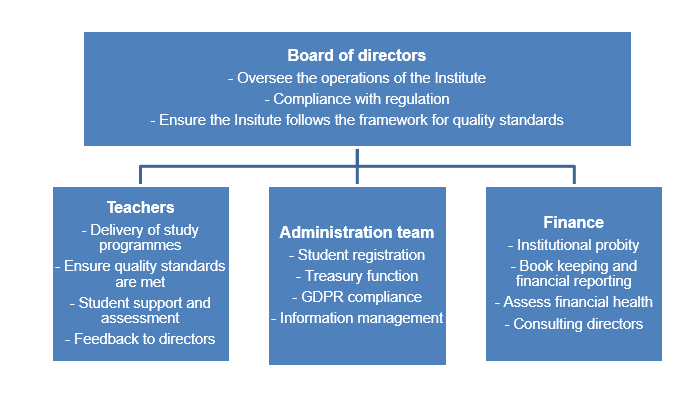
1. Policy for quality assurance
The aim of implementing quality assurance systems is to ensure the ongoing application and improvement of qualitative methods that ensure the training and development of students.
A system for quality assurance will be implemented that:
- Promotes a culture of quality, where the actions of its staff and course participants are inspired by a desire to continuously improve their practice, learning experience and outcomes.
- Ensures that tutors are suitably qualified and up to date with recent regulation and methods on the subject area of tuition.
- Implements a curriculum of studies that is adequately documented to support the student development as well as can be assessable by students.
- Monitors student performance through testing of the subject area and in class discussions.
- Analyses key deliverables such as number of students leaving training, number of students successfully completing a course, and increase in students year on year.
- Provides feedback and means for students to help them achieve better understanding of the area of study. This can include one to one appraisals, providing notes on mistakes made and providing further study material and requesting feedback.
- Evaluates the training being provided is delivering on expectations of the Institute, students and other stakeholders who are interested in the educational services being provided.
2. Institutional probity
The Company will appoint Directors who will be responsible for the leadership, management and continued trading of the Institute. The Directors will be appointed based on their experience and knowledge of running a business. Directors of the Company will be expected to have at least 3 years leadership experience in the same or similar line of business.
A qualified accountant, who is a member of a recognized accountancy body and holding warrant as certified public accountant, will be appointed to take responsibility of book keeping, preparation of accounts, payroll and submitting tax and other statutory returns. Furthermore the Company will appoint an external independent auditor to ensure that annually an independent audit is carried out of the business financial records. The auditor will also be a member of an accountancy body and will hold warrant as certified public accountant and auditor.
The financial management of the Institute will be monitored through annual budget and cash flow forecast. The budget will note expected student number and cost targets, and the cash flow will set forecast cash levels to maintain liquidity for the continued operations of the Institute.
Board meetings will be held quarterly to review budget and cash flow targets. During these meetings the Directors will discuss any specific weaknesses and threats to set budget and cash flow levels and take corrective action as appropriate. The aim is to align the business to remain competitive, cost efficient and able to continue providing tuition.
In addition, the directors will carry out regular reviews of internal controls and procedures to ensure the transparency and correct application of funds received. These reviews will also be on the agenda of board meetings.
3. Design and approval of programmes
Course programs will be setup that consider the following:
The expected entry requirements from interested students
Students applying for courses will be requested to provide their academic record together with any work experience. These will be evaluated to understand better the support required and whether a course will meet expectation of all parties involved. Feedback will be given on the adequacy of qualifications and work experience for the course applied for, principally by email. Feedback may include recommendation for applying for different courses if need be or an assessment on how best to prepare for the course on offer.
The learning objectives of courses available
Each course will focus on a specific topic of study and will have a designated programme of learning. Topics will be relevant to the subject matter and will also accommodate for a degree of flexibility to enable the continuous improvement of learning experience through feedback from students.
The amount of hours of training given
Each course will have an allocated time frame within which it will be delivered. The hours will be based on the programme deliverables including examination and the student level. It will include all the required knowledge to be achieved plus any assignments. The length of time will be appropriate to deliver the course contents and enable student to successful pass their exams.
Student engagement in the training provided
This will be achieved through in class discussions, hands on training in simulation exercises and testing throughout and at the end of course.
Study resources available, including online research
Each course will be supported by specific training guides and manuals. It will also provide students with information about any other knowledge resource including online research, and practical assignments where possible. This will ensure that students make full use of all available study material thus ensuring the successful delivery of the course.
Expected time spent on assignments and home study
Part of ensuring that courses successfully deliver the tuition applicable is to prepare students for the expected amount of personal study time they are required to do. This will be another important part when setting up a course, in that students will be expected to carry out assignments, personal study and other research work that will motivate them as part of their development.
Student feedback for continued improvement
Student will be provided with a short questionnaire at the end of the course in order to obtain feedback on areas of tuition such as the clarity of communication from the tutor, whether course material was relevant to their expectation, whether study material provided helped in their training, and if there is any other suggestion for improving the courses.
4. Student-centred learning, teaching and assessment
The Institute recognises the importance of getting a student involved, specifically to ensure that a student actively gets involved in the learning process. This will keep a student motivated to achieve its goals. The Institute is focused on providing high quality teaching, learning and assessment to all course participants irrespective of gender, race, religion, belief, disability or sexual orientation.
Engagement and participation
Students are likely already self-motivated towards learning the chosen area of study. This is mainly down to their objectives and curiosity from learning something new. However the Institute recognizes the importance of keeping students engaged. This can be achieved through appraising students, one to one review of work done by a student, challenging students in different assignments, building a culture of responsibility, demonstrating the applicability of the subject being taught and student feedback.
Engagement will lead to participation. The Institute believes that students should be helped in building a mindset of responsibility, hard work and self-determination in achieving their goal. Students will be encouraged to lead, to provide feedback and to actively seek to question instead of simply listening.
Communication and student interaction
Two way communication is key to the successful delivery of the Institute’s learning objectives. Students will be encouraged to discuss matters, to seek advice from the tutor, to make suggestions, to discuss with other students, and to proactively research the subject. Tutors will provide feedback both written and by discussing the results of assignments. Tutors will also encourage students to carry out research on the subject matter
Assessment
A key element of teaching a subject is assessment of a student’s performance. Assessment refers to the procedures in place to evaluate a student’s knowledge and performance of a subject matter and provide necessary feedback and information to the student.
The Institute will implement rigorous but fair assessment of students, from when a student applies to join a course, during training, and at exam level. All three stages of assessment will be conducted with the following principles:
- Procedures for assessment are clearly laid out to students, staff and other interested parties.
- Appropriate due diligence and clear feedback given to ensure the proper development of the student and the achievement of the objectives of all parties involved.
- All students irrespective of gender, race, religion, belief, disability or sexual orientation will be subject to the same procedures.
- Assessment will vary depending on programme of study in order to effectively address different subjects and stages of study.
All students will be assessed equally and will be subject to the same evaluation procedure. This is of importance for the students to ensure that all course participants successful achieve their study objectives and for the Institute to continue growing by attracting more students.
Assessment will need to be timely, thus enabling a student to take corrective action when required. For assessment to be timely, there will be the need for the teacher to monitor a student’s performance regularly, and ensure that effective two way communication exists.
Support
The Institute recognizes the importance of support to students. It is therefore committed towards providing any advice, as far as practical, on matters which somehow effect their study. Students are in fact to discuss matters directly if required with the tutor to ensure that their study experience is successful.
5. Student admission, progression, recognition and certification
The Institute’s quality procedures have been designed around the student’s life cycle with the Institute. This will involve implementing procedures at application, during training and upon completion of the training.
Admission
The Institute is open to anyone, irrespective of background, ethnicity, religion or sexual orientation. There will however be specific entry requirements depending on the chosen area of study. Specific forms will need to be filled and emailed to the Institute. The forms, apart from personal detail, will include the requirement to provide reason for choosing the course, and request the applicant to answer as to the applicability of the course once qualified. The Institute will review and assess the application received. Feedback will be given by email that includes any specific requirements to prepare for the course, and may also include information on other courses that may be available.
Progression
The Institute recognizes the importance of positive progression in studies of a student. This will help motivate the student to eventually qualify from the Course. To achieve such an important aim, tutors will monitor student grades throughout the course in assignments and mock tests. Feedback will be two way, in that tutors will encourage students to communicate back so that any setbacks are managed and hence adequately addressed.
Recognition and certification
Students who successfully pass final exams will receive qualification appropriately designated to the corresponding course attended.
Teaching staff
The institute will employ tutors that are suitably qualified and provide them with any required training for on- going professional development, including furthering their technical knowledge, teaching skills and communication.
Potential applicants for the position of teacher with the institute will need to have at least 3 years teaching work experience and at least same amount of years working in health and safety or related compliance field. All potential teachers will adhere to the quality standards of the Institute and will be responsible for the setup, implementation and constant improvement of the institute’s course. All applications received, irrespective of age, religion, ethnicity and sexual orientation, will be reviewed and assessed against the criteria required for the position on offer. Applicants meeting the criteria requested will be short listed and interviewed. Any decision taken will be solely based on skills, talent and the expected ability to deliver teaching effectively.
The Institute will review performance indicators, such as class attendance, exam results and feedback from students to ensure that teachers meet expectations of all parties involved.
The Institute will provide necessary support and training required to ensure the Continued Professional Development to Teachers, ensuring tuition is effectively and efficiently delivered.
Teachers at the Institute will in fact be required to attend accredited any internal (organized by Institute) and external courses (provided by third parties) and carry out any personal study and research to ensure they meet their Continued Professional Development (CPD). They are also expected to enhance their knowledge and skills in teaching, communication and leadership and management as part of their role within the Institute.
7. Learning resources and student support
Students requiring special needs may seek assistance from the tutor or provide information on specific requirements upon application. The Institute will provide adequate means to ensure such students receive the same training as any other student.
The Institute will monitor the attitude and behavior of students. Students will receive adequate attention to both their personal and social development. The aim is to provide any necessary coaching or guidance which will help develop the student not only on the topic taught but also personally. In this regards, student attendance will be carefully monitored and supportive action is taken on poor performance.
No bullying, discrimination or other form of intolerances against students or teachers is accepted within the Institute. Any such reports will be thoroughly investigated and corrective action taken.
The Institute will provide copies of slides, and online references for student research and study. The Institute will also provide lists of text books to purchase. Students will be grouped in small numbers to ensure adequate interaction with tutor. Students will be taught through slides, white board and direct interaction.
8. Information management
As part of its operations the Institute will collect and hold personal data about students as well as other key information such as class attendance, exam results, feedback from students and recommendations from teachers. All such data will be processed, recorded and stored in accordance to General Data Protection Regulation (GPPR) in Malta.
Considering the volume of documentation involved, data will mainly be collected, stored and supplied online subject to certain exceptions such as application forms, and written reports from tutors. Online data will be stored electronically with daily backups taken of hard drives to ensure no data is lost. Online security software will be used to ensure the complete security of private and sensitive information. Any physical documentation will be scanned and stored electronically, and then kept in a secure filing cabinet. Employees handling private information will be explained the requirements of GDPR and explained how data can be stored and not provided unless authorization is given.
All feedback forms and other written suggestions will be checked individually and a proper and rigorous assessment carried out to ensure the improvement in the service being provided.
The Institute will use key performance indicators, such as student turnover, success rate, rating given by students on their feedback form and growth in student number to assess the quality of teaching provided by the Institute. Through such monitoring, the Institute aims to build quality in the tuition provided and hence ensure student motivation and successful completion of courses.
9. Public information
The objective of the Institute is to provide clear knowledge to the public of the courses provided so as to enable a potential student to make an informed judgement on whether to attend the course. To attain this we will provide prospective students with course details, entry requirements, tuition methods, suggested readings assessment methods, qualifications to be achieved and the expected career path from the course. This information will be available online and via letter by post to the applicant.
Through the Institute’s website, any potential applicants can review the courses available, requirements for such courses, and make enquiries by email if required. All queries received will be reviewed and an adequate response provided within a relatively short period of time. The reply will include all necessary details and supporting documentation.
10. Ongoing monitoring and periodic review of programmes
The Institute will carry out ongoing reviews of courses provided as part of ensuring the effective implementation of a quality management system.
The purpose of course reviews are:
- evaluate the effectiveness of programmes and assess whether students are achieving learning objectives.
- review feedback from tutors, students, professional bodies and other interested stakeholders. implement improvements to the study programmes.
- ensuring the continued applicability and hence validity of current training being provided including the methods used to deliver the training.
- analyzing the methods currently applied in providing tuition to ensure the Institute’s and Students’ objectives are aligned.
- identify areas for improvement to ensure that appropriate actions are taken in time to any weaknesses or threats to the Institute’s operations.
- increase participation from students, and other stakeholders including external parties for support to the development and enhancement of study programmes.
All courses are planned with the objective to deliver a specific area of knowledge to students. This objective will need to be analysed against results, and reviewed in detail based on feedback received from both students and teachers.
Reviews will be carried at end of each course, after exam results. They will be a part of board meetings as part of the review of the operations of Institute. During the meeting, all necessary information will be laid out to the directors who will review key statistic items such as exam results, average passmarks and student in-class participation, as well general feedback received from both tutor and student. Any necessary action required, will be implemented without delay prior to the commencement of the successive respective course. In case where significant changes occur, for example the need to expand further the course, or a new course setup, the Institute will notify NCFHE, and the institute’s website will be update accordingly.
11. Cyclical external quality assurance
We understand that as an institution providing tuition to the public will expect to undergo external quality assurance by, or with the approval of the NCFHE on a cyclical basis according to NCFHE guidelines, once every five years. Therefore we shall retain any necessary records to meet such a requirement.